Lapis lazuli appears by name in several modern English Bible translations, but readers who compare versions quickly encounter a puzzle: one Bible may say “lapis lazuli” while another says “sapphire” in the same verse.
Short answer: Yes, several modern Bible translations—including the NIV—use lapis lazuli in multiple passages. Other translations use sapphire for the same ancient term. The disagreement exists because biblical gemstone names do not always correspond neatly to modern mineral classifications, and lapis lazuli is a well-supported historical identification for Hebrew sappir, though the identification is not universally expressed the same way in Bible translations.
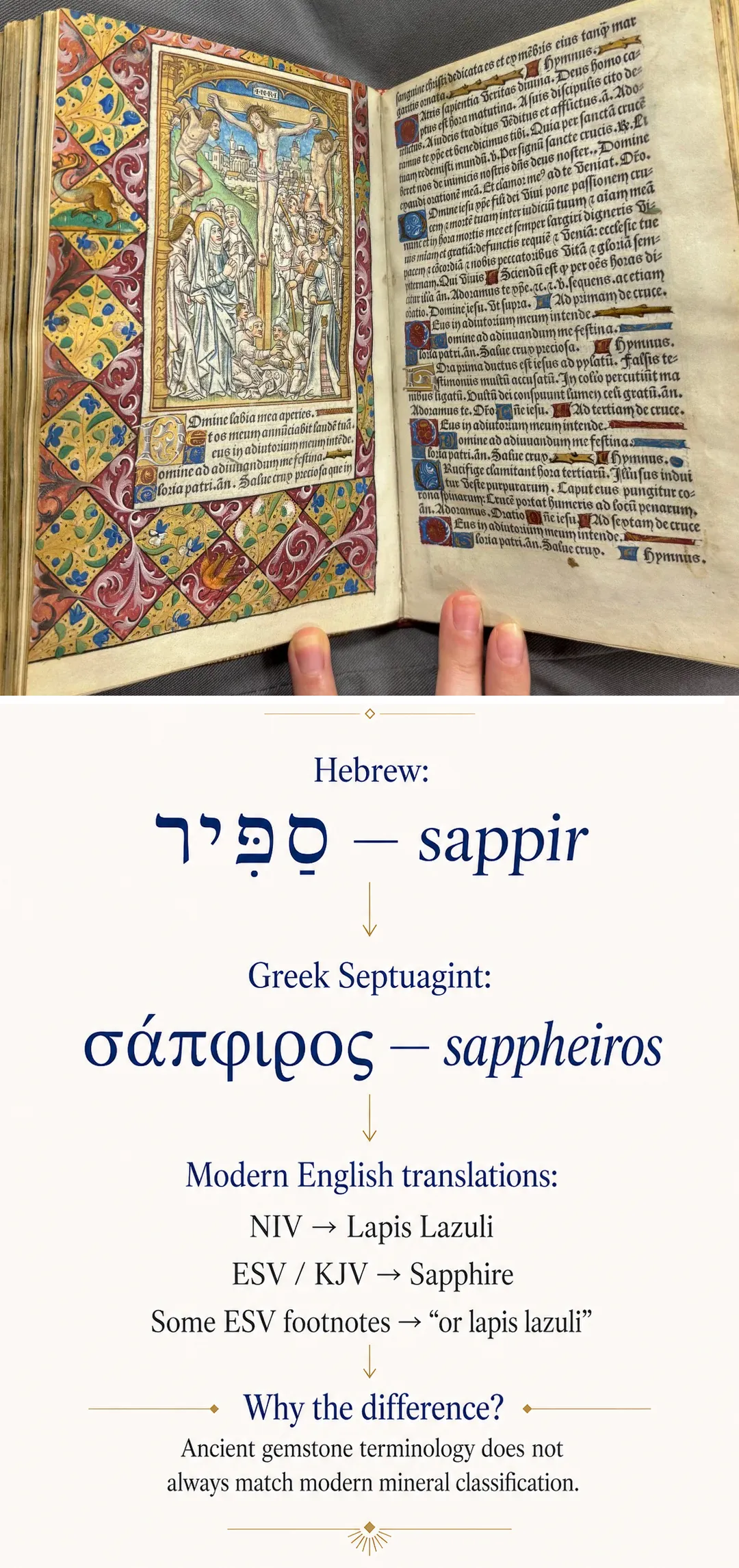
The difference is not simply a translation mistake. Ancient gemstone names do not always correspond neatly to modern mineral classifications. The Hebrew word sappir (סַפִּיר), later represented by the Greek sappheiros, has been translated in different ways, and scholars and dictionaries have not always agreed on its exact modern equivalent.
That makes the story of lapis lazuli in the Bible more interesting than a simple list of symbolic meanings. To understand it properly, we need to separate what the biblical texts actually say, what translators disagree about, and what later traditions have added.
Is Lapis Lazuli Actually Mentioned in the Bible?
Yes—in some modern translations.
The New International Version (NIV) uses the words lapis lazuli in passages including Exodus 24:10, Exodus 28:18, Exodus 39:11, Job 28:6 and 28:16, Isaiah 54:11, Ezekiel 1:26, and Ezekiel 10:1.
Other translations often use sapphire in the same places.
For example, Exodus 24:10 in the NIV describes something beneath the feet of the God of Israel as a pavement resembling lapis lazuli and compares its blue appearance with the sky. The ESV, KJV, and NKJV instead use sapphire for the same material.
The same difference appears in the high priest’s breastpiece. Exodus 28:18 in the NIV places lapis lazuli in the second row of stones, while the ESV and KJV use sapphire.
So the most accurate answer is not simply:
“The Bible mentions lapis lazuli.”
A better answer is:
Several modern Bible translations identify the ancient stone as lapis lazuli, while others retain the traditional English translation “sapphire.”
Understanding why requires looking at the ancient word behind both translations.
Lapis Lazuli or Sapphire? Understanding the Hebrew “Sappir”
The key Hebrew term is sappir (סַפִּיר).
At first glance, it looks obvious that sappir must mean modern sapphire. The English word sapphire itself ultimately developed through related ancient Greek and Latin terms.
But that linguistic similarity can be misleading.
Modern sapphire is a variety of corundum, normally transparent to translucent and extremely hard. Lapis lazuli, by contrast, is an opaque blue rock composed mainly of lazurite together with minerals such as calcite and pyrite.
Ancient writers did not classify gemstones according to today’s mineralogical systems. They often distinguished valuable stones through properties such as color, appearance, rarity, origin, and practical use.
A 2020 scholarly study by Jacobus A. Naudé and Cynthia L. Miller-Naudé examined biblical gemstone terminology through the Hebrew Bible, Septuagint, ancient literature, lexicography, and mineral identification. The authors note that dictionaries themselves disagree: some translate sappir as sapphire, some allow both sapphire and lapis lazuli, while others identify it specifically as lapis lazuli. Their study argues that the Hebrew and Greek terms in the biblical context refer to lapis lazuli rather than automatically to the modern corundum gemstone now called sapphire.
This is why responsible discussion should avoid claiming that every biblical occurrence has been proven beyond dispute to be lapis lazuli.
The stronger conclusion is:
Lapis lazuli is a well-supported historical and scholarly identification for biblical sappir, while English Bible translations continue to reflect different translation traditions.
Where Does Lapis Lazuli Appear in the Bible?
The translation difference becomes easiest to understand when the passages are compared side by side.
| Passage | NIV | Traditional / Other Translations | Context |
|---|---|---|---|
| Exodus 24:10 | Lapis lazuli | Sapphire | Blue pavement beneath the divine presence |
| Exodus 28:18 | Lapis lazuli | Sapphire | High priest’s breastpiece |
| Exodus 39:11 | Lapis lazuli | Sapphire | Breastpiece stones |
| Job 28:6, 16 | Lapis lazuli | Sapphire; some footnotes allow lapis | Precious material contrasted with wisdom |
| Song of Songs 5:14 | Lapis lazuli | Sapphire in some translations | Poetic description |
| Isaiah 54:11 | Lapis lazuli | Sapphire; ESV notes lapis | Foundations of restored Jerusalem |
| Lamentations 4:7 | Lapis lazuli | Sapphire; ESV notes Hebrew lapis lazuli | Description of appearance |
| Ezekiel 1:26 | Lapis lazuli | Sapphire | Heavenly throne |
| Ezekiel 10:1 | Lapis lazuli | Sapphire | Heavenly throne |
| Ezekiel 28:13 | Lapis lazuli | Sapphire | Precious stones in Eden imagery |
The differences are visible directly in current Bible translations and footnotes.
Exodus 24:10 — Blue Like the Sky
Exodus 24:10 provides one of the strongest visual clues.
The passage describes a precious blue material beneath the divine presence and explicitly compares its appearance with the sky.
That does not establish a modern mineral identification by itself, but it clearly establishes blue celestial imagery.
This passage is therefore an important reason lapis lazuli has become associated, in biblical discussion, with heaven, divine presence, and majesty.
The symbolism comes from the imagery of the passage—not from a claim that the stone itself possesses supernatural power.
Exodus 28:18 & 39:11 — The High Priest’s Breastpiece
Exodus describes twelve precious stones mounted on the breastpiece worn by the high priest.
In Exodus 28:18 and the parallel description in Exodus 39:11, the NIV identifies one of these stones as lapis lazuli, whereas many traditional English translations call it sapphire.
The biblical context clearly gives the stone a place within a sacred priestly object.
However, care is needed when assigning a specific stone to a specific tribe of Israel. The text connects the twelve stones collectively with the twelve tribes but does not provide an uncontested stone-by-stone modern identification and tribal mapping. Later traditions have proposed different correspondences.
Ezekiel 1:26 & 10:1 — The Throne
Ezekiel’s visions provide another important connection.
The NIV describes what appeared to be a throne of lapis lazuli in Ezekiel 1:26 and again uses lapis lazuli for the throne-like appearance in Ezekiel 10:1. Other versions use sapphire, while the ESV itself notes lapis lazuli as an alternative reading in Ezekiel 1:26.
Here the stone appears in imagery surrounding a heavenly throne.
This provides a strong textual basis for associating biblical lapis imagery with:
majesty, heavenly authority, and divine glory.
Job 28 — Precious, but Wisdom Is More Valuable
Job 28 is especially useful because the stone appears in a passage about wisdom and value.
The NIV uses lapis lazuli in verses 6 and 16. Other translations use sapphire, while the ESV gives lapis lazuli as an alternative identification in its note for verse 6.
The larger point of the chapter is not that the stone itself produces wisdom.
Instead, precious materials—including this valuable blue stone—are used to demonstrate that true wisdom cannot simply be purchased like a gemstone.
That distinction matters when discussing the modern claim that lapis lazuli is a “stone of wisdom.”
Revelation 21:19 — Sapphire or Lapis Lazuli?
Revelation 21:19 is a related but slightly different case because the New Testament was written in Greek rather than Hebrew.
Revelation 21 describes the foundations of the New Jerusalem as decorated with precious stones.
Most familiar English translations call the second foundation sapphire.
But the identification is not completely straightforward. The World English Bible, for example, gives lapis lazuli as an alternative in its footnote, while the NIV itself warns that the precise identification of some of the gemstones in this passage is uncertain.
For that reason, it would be too strong to write:
“The second foundation of the New Jerusalem was definitely lapis lazuli.”
A more accurate statement is that lapis lazuli has been proposed as the ancient material behind the term traditionally translated as sapphire.
Why Scholars Connect Biblical Sappir With Lapis Lazuli
There are several reasons the lapis lazuli identification deserves serious consideration.
First, ancient gemstone names did not operate according to modern chemical mineral classifications. The same ancient word could pass through Hebrew, Greek, Latin, and later European languages while its physical referent gradually changed.
Second, lapis lazuli was already a prestigious material throughout the ancient Near East. Archaeological and historical evidence demonstrates its use in Mesopotamia and Egypt thousands of years before the biblical period. GIA notes that lapis lazuli has been treasured for approximately 6,500 years and was valued by ancient civilizations including Mesopotamia and Egypt.
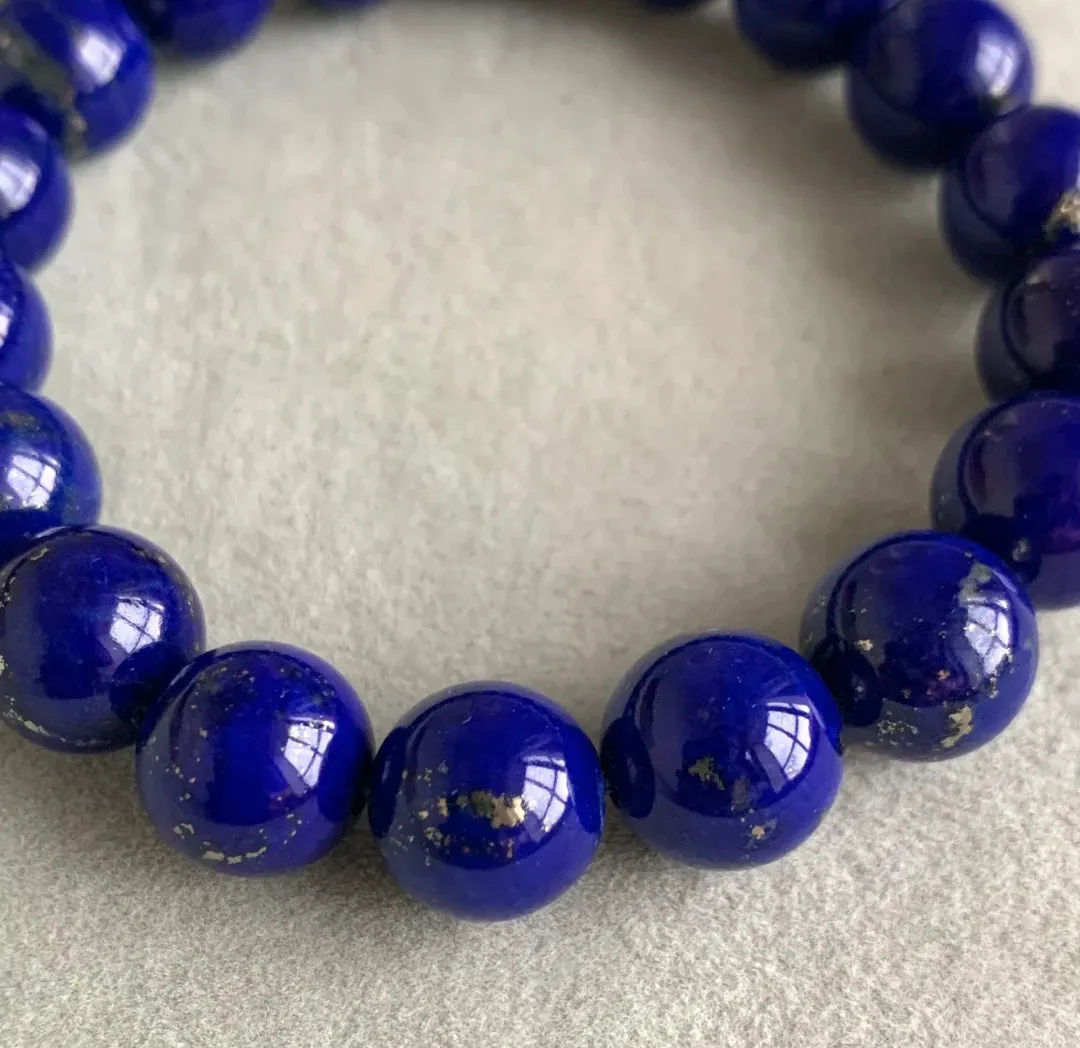
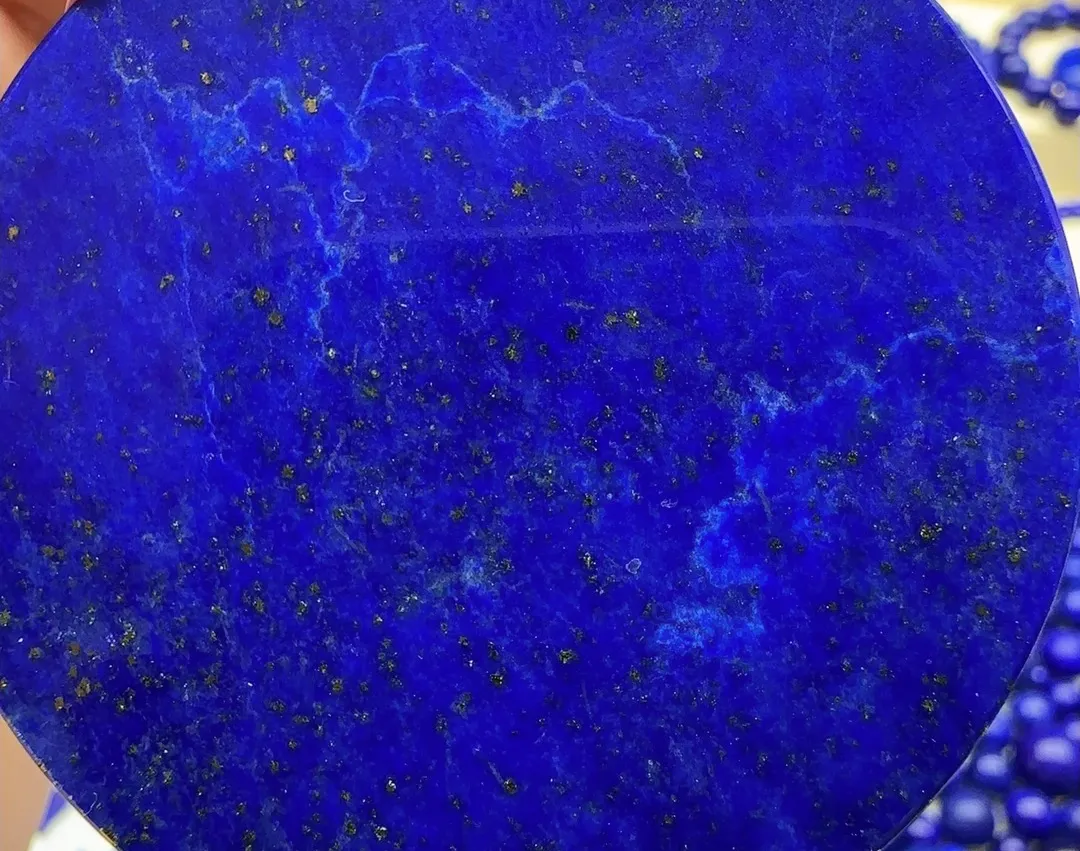
Third, the physical material fits many ancient descriptions better than a modern reader might expect. Lapis lazuli is an opaque blue rock whose rich color comes largely from lazurite; it may also contain white calcite and glittering gold-colored pyrite.
None of these points alone “proves” the identity of every biblical sappir.
Together with linguistic and textual evidence, however, they explain why lapis lazuli is not a speculative modern invention but a serious scholarly identification.
What Does Lapis Lazuli Symbolize in the Bible?
A useful way to answer this question is to separate symbolism supported by the biblical imagery from meanings added much later.
Heaven and the Sky
Exodus 24:10 directly connects the blue stone with the appearance of the heavens.
This makes heaven or celestial imagery one of the strongest biblical associations.
Divine Majesty and Authority
In Ezekiel 1:26 and 10:1, the blue precious material appears in the description of a throne.
It is therefore reasonable to associate the imagery with majesty, kingship, and heavenly authority.
Sacred and Priestly Use
Its place among the stones of the high priest’s breastpiece connects it with a sacred ritual context.
That supports associations with preciousness and priestly significance, although we should not invent a specific spiritual power that the text never states.
Extraordinary Value
Job 28 places the stone among materials of great value while arguing that wisdom is worth even more.
The passage shows that the material was understood as precious.
It does not say that wearing the stone gives a person wisdom.
For a broader look at how the meaning of lapis lazuli developed across ancient cultures and later spiritual traditions, see our Lapis Lazuli Meaning guide.
Biblical Meaning vs. Modern Crystal Meaning
This distinction is especially important.
Modern crystal and metaphysical traditions frequently associate lapis lazuli with:
truth, communication, intuition, the throat chakra, the third-eye chakra, meditation, and self-expression.
Those beliefs belong to modern spiritual or metaphysical traditions.
They are not teachings found in the Bible.
The Bible does provide imagery connecting the ancient blue stone with the heavens, preciousness, priestly objects, and throne imagery. But it does not teach that lapis lazuli activates chakras, treats health conditions, improves communication, or produces supernatural effects when worn.
Readers interested in the material itself—including its mineral composition, pyrite, calcite, treatments, identification, and jewelry uses—can read our Lapis Lazuli Crystal Guide.
This separation allows both traditions to be discussed accurately without presenting one as evidence for the other.
What Does Real Lapis Lazuli Look Like?
Modern lapis lazuli gives us a useful visual reference for understanding why this ancient blue material attracted so much attention.
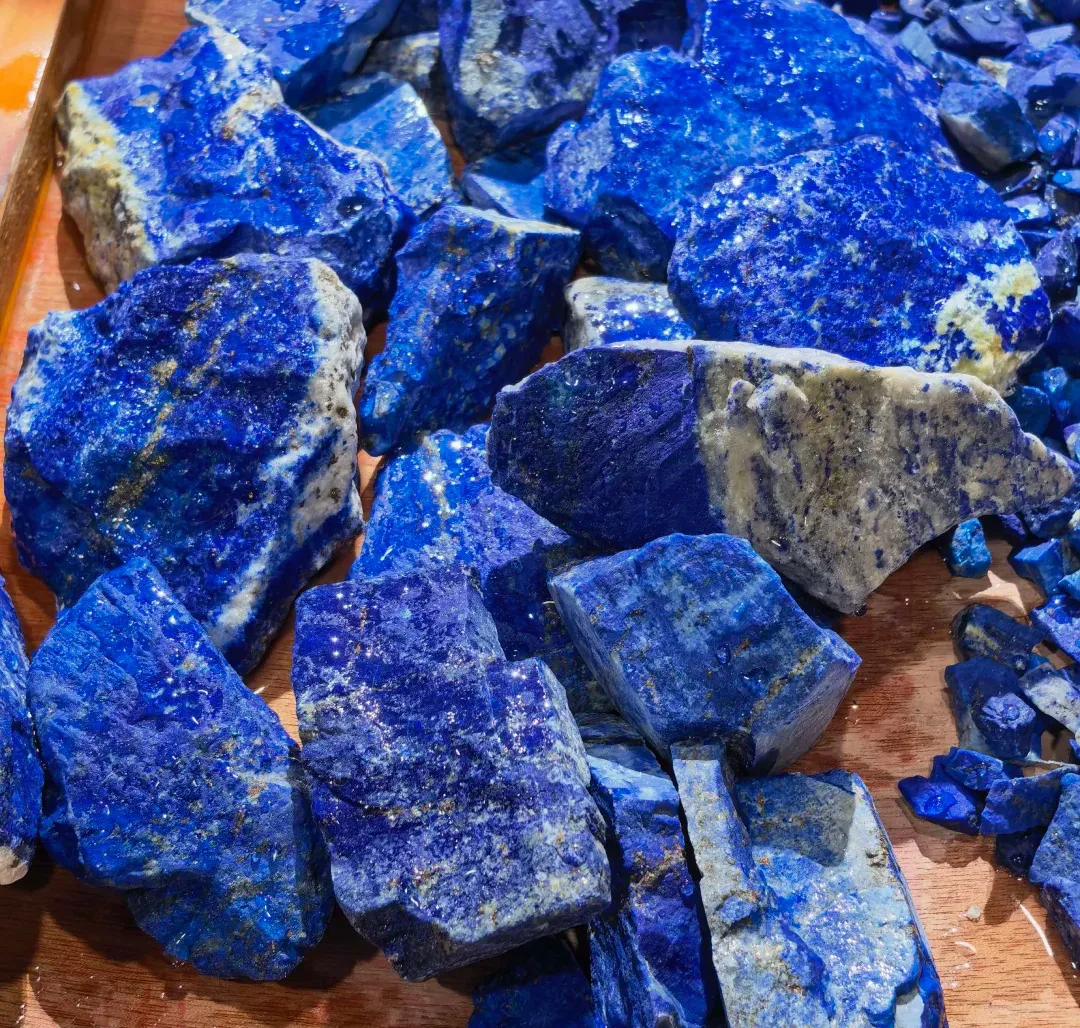
According to GIA, lapis lazuli is a rock composed primarily of minerals including lazurite, calcite, and pyrite. Lazurite is responsible for much of its prized blue color, calcite can appear as pale or white areas, and pyrite commonly produces metallic gold-colored flecks.
Natural specimens therefore do not all look identical.
Some are almost uninterrupted blue. Others contain visible metallic flecks or pale mineral patterns.
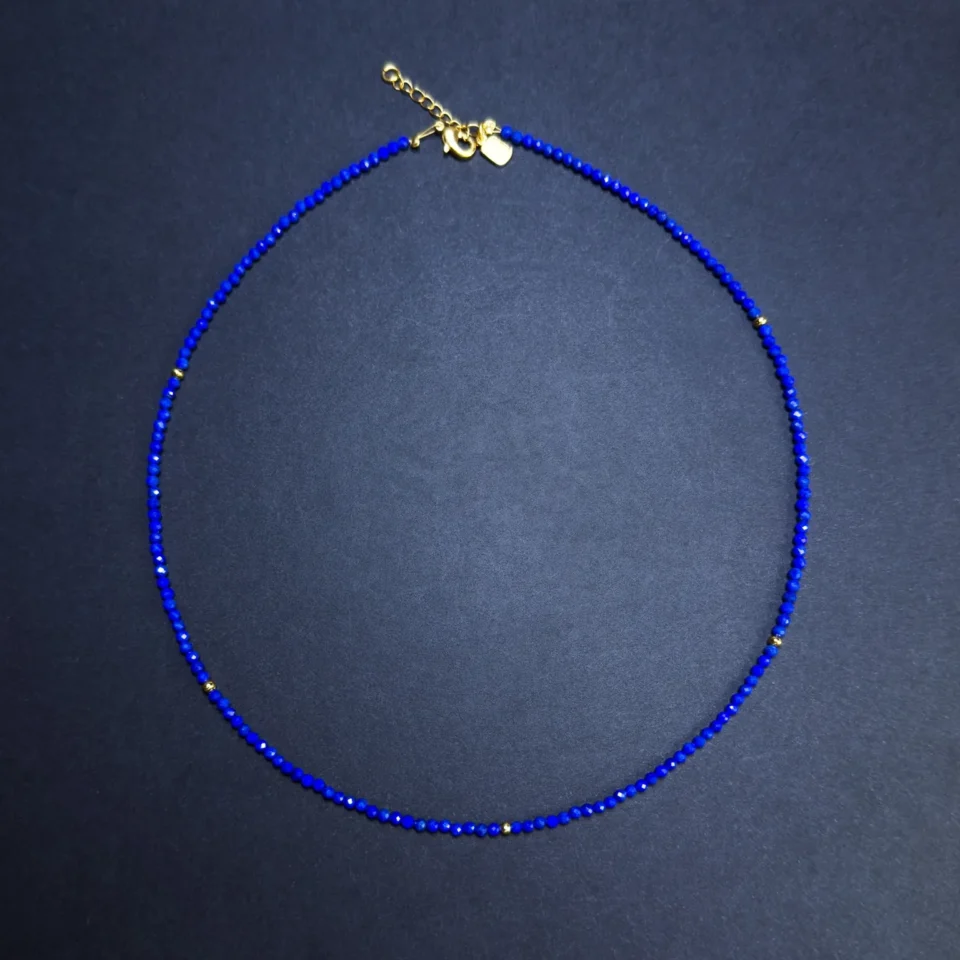
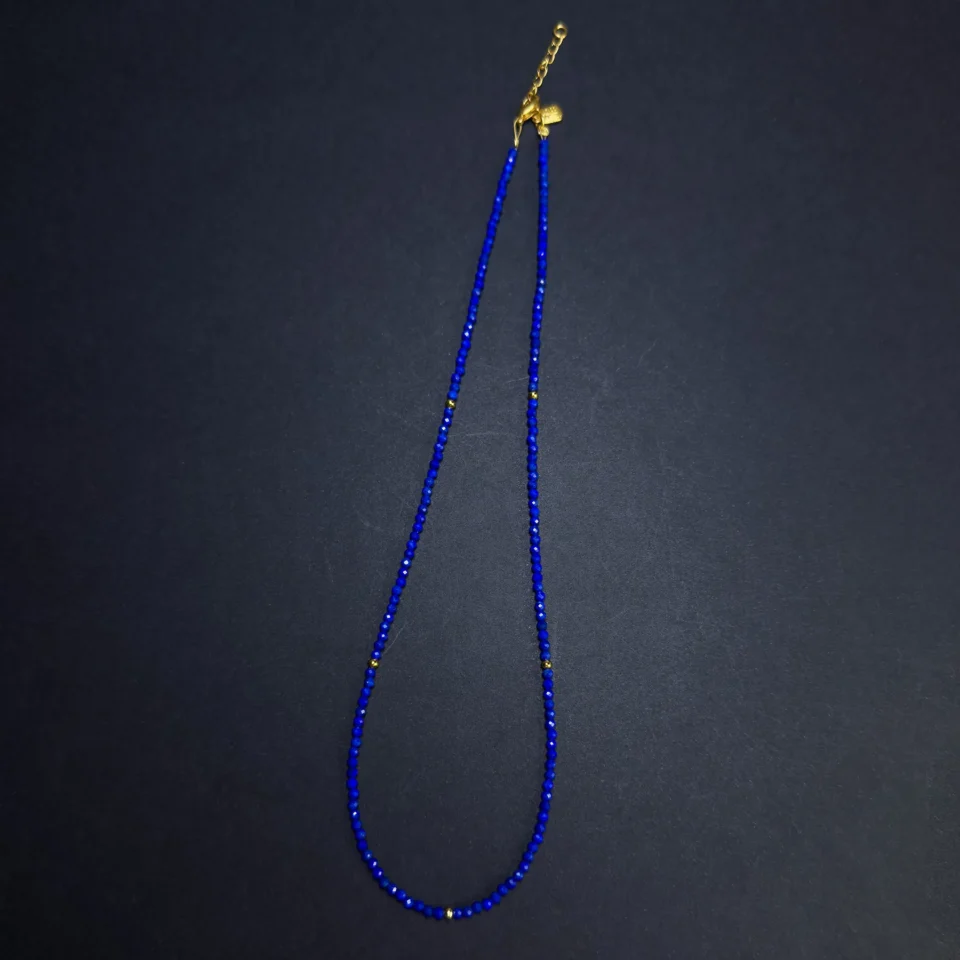
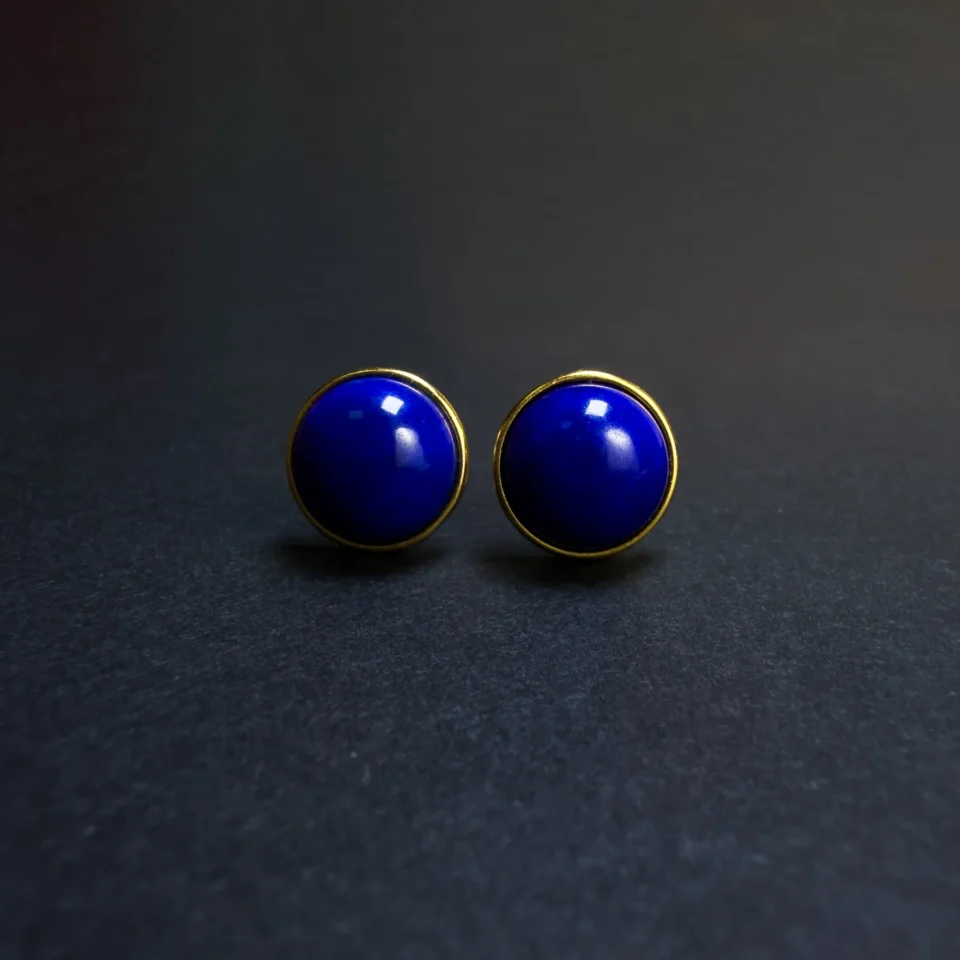
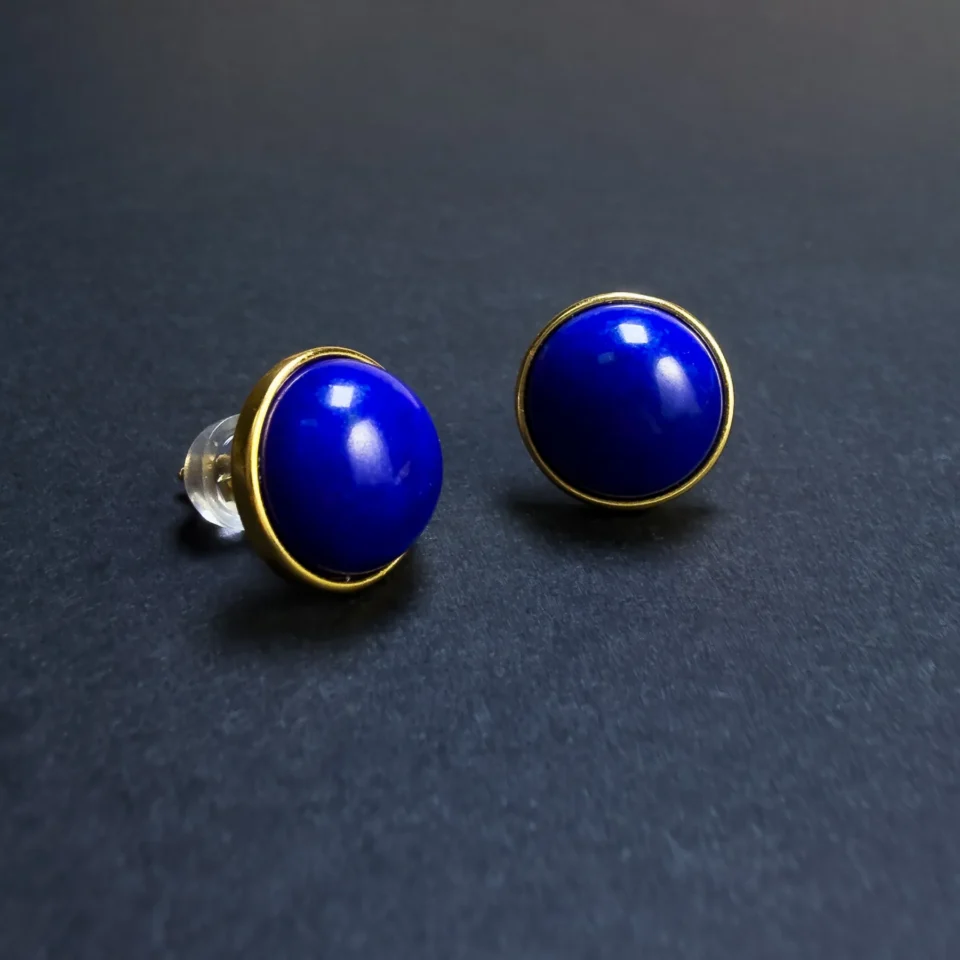
Our Blue Lapis Lazuli Guide shows real examples of how blue tone, mineral pattern, calcite, pyrite, and matching can change the appearance of lapis lazuli jewelry.
Frequently Asked Questions About Lapis Lazuli in the Bible
Is lapis lazuli mentioned by name in the Bible?
Yes, several modern translations—including the NIV—use lapis lazuli in multiple Old Testament passages. Other versions translate the same ancient term as sapphire.
Why does the KJV say sapphire while the NIV says lapis lazuli?
The translations reflect different decisions about the ancient Hebrew word sappir. Modern sapphire and ancient sappir are not necessarily the same mineral, and scholars have proposed lapis lazuli as the historical referent.
What does lapis lazuli represent in biblical imagery?
The clearest associations are with the sky or heavens, preciousness, sacred priestly settings, and heavenly throne imagery. Broader meanings such as chakras or crystal healing come from later traditions, not from the Bible.
Was the high priest’s breastpiece made with lapis lazuli?
The NIV identifies one of the stones as lapis lazuli in Exodus 28:18 and 39:11. Other translations call it sapphire. The ancient stone is therefore better described as a debated identification rather than an absolutely certain modern mineral assignment.
Is the sapphire in Revelation 21:19 actually lapis lazuli?
It is possible, but not certain. Most modern translations say sapphire, while some translation notes recognize lapis lazuli as an alternative. Even the NIV notes that precise identification of some gemstones in Revelation 21 is uncertain.
A Blue Stone, an Ancient Word, and a Translation Question
The story of lapis lazuli in the Bible is not simply about assigning spiritual meanings to a gemstone.
It is also a story about language.
The Hebrew sappir belonged to an ancient world in which precious stones were understood differently from the way mineralogists classify gemstones today. As those ancient terms passed through Greek, Latin, and eventually modern English, the familiar word sapphire survived—but the material behind the ancient word may not always have been the transparent blue corundum we now call sapphire.
That explains why one modern translation can describe a pavement, priestly stone, or heavenly throne as lapis lazuli, while another calls the same material sapphire.
What remains consistent is the biblical imagery:
a precious blue material associated with the sky, sacred objects, extraordinary value, and visions of divine majesty.
Understanding that distinction gives us something more useful than another list of gemstone “powers.”
It lets us see how an ancient blue stone, biblical language, and modern gemology intersect—and where certainty ends and interpretation begins.
For readers who want to explore the gemstone in modern jewelry, you can also browse our Lapis Lazuli Jewelry Collection.