Sodalite and lapis lazuli are not the same material. Sodalite is a mineral. Lapis lazuli is a rock composed of several minerals, mainly blue lazurite together with varying amounts of calcite, pyrite and other minerals. That difference is fundamental, and it helps explain why the two stones do not look or behave exactly the same.
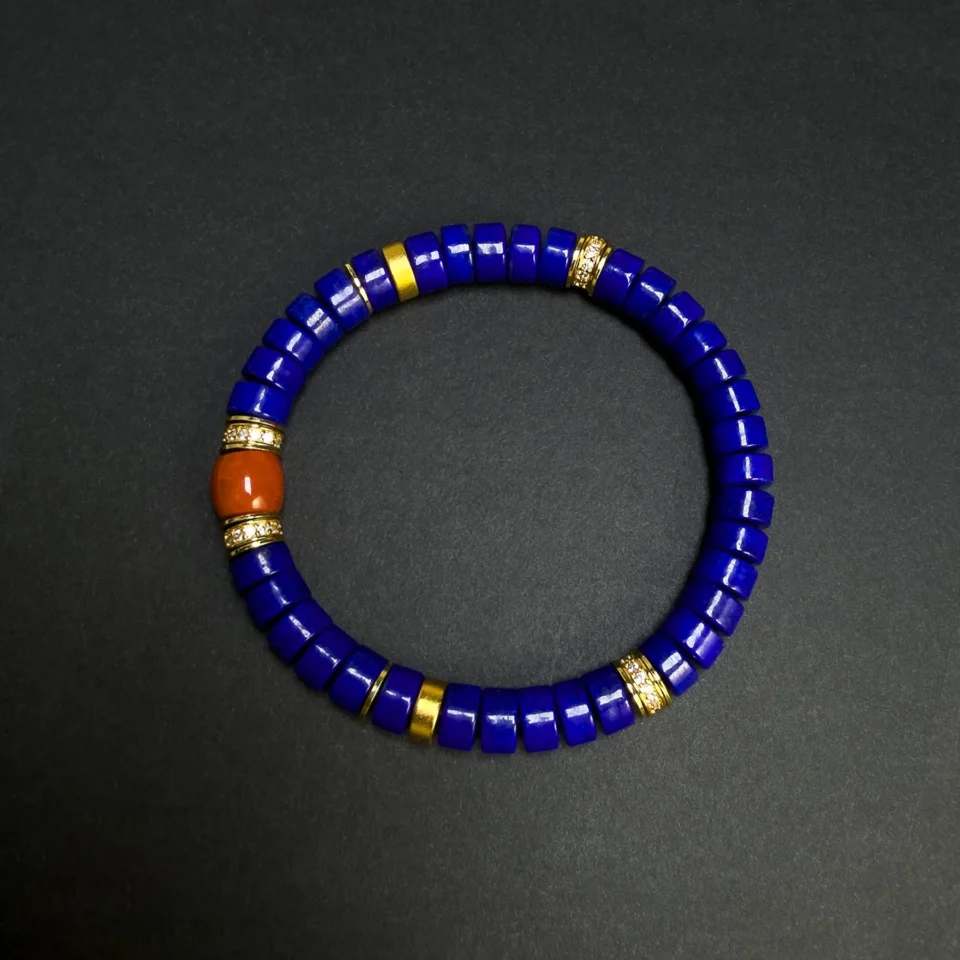
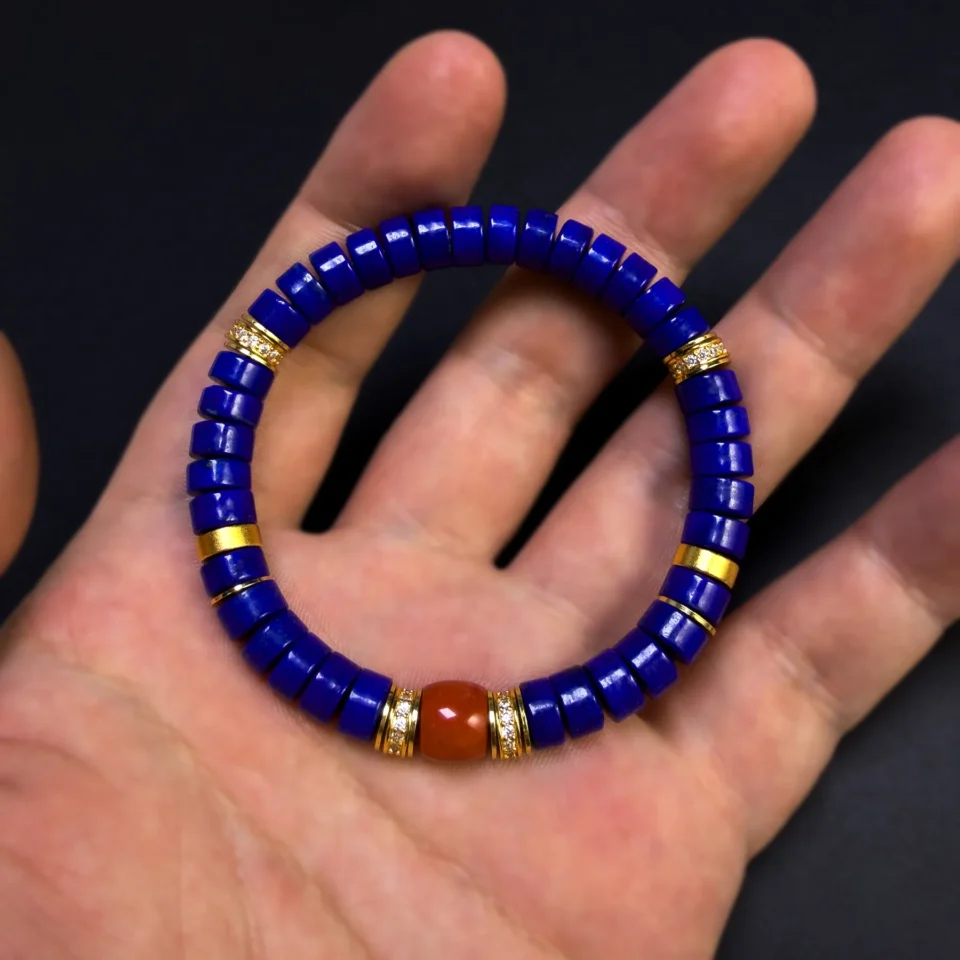
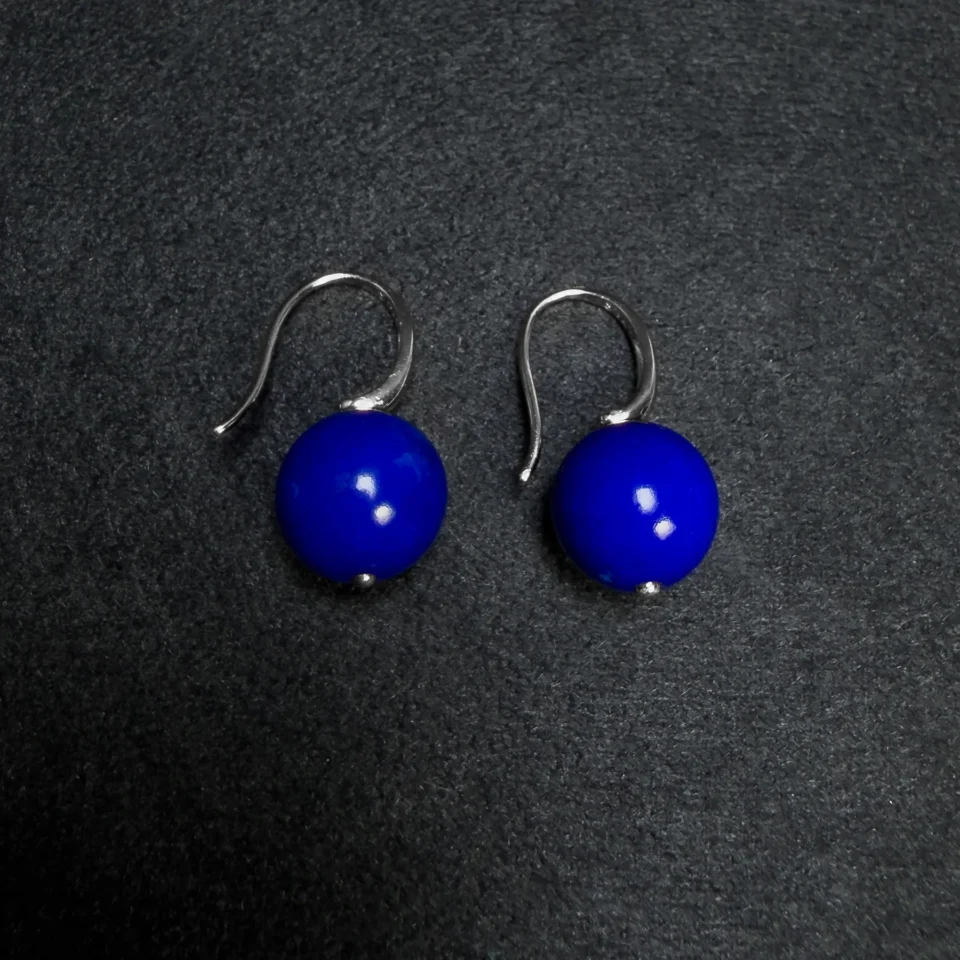
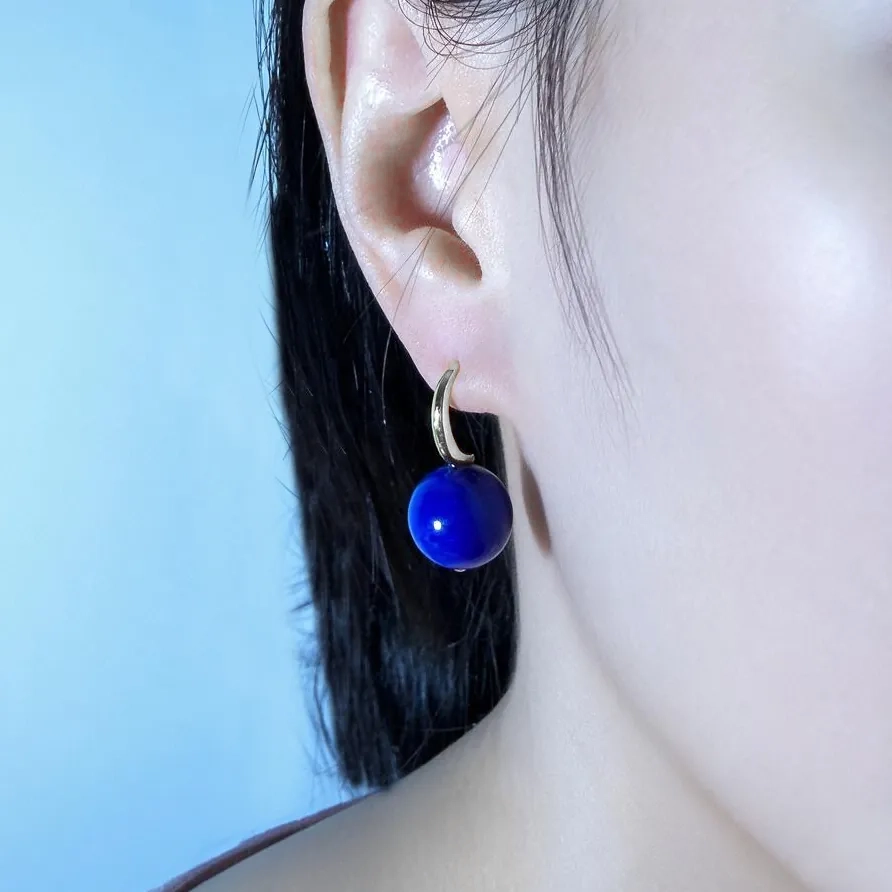
They are both blue, but in typical jewelry material the blue is usually different enough to see. Sodalite often reads as a softer, grayer or more violet-blue, frequently broken by cloudy white areas. Fine lapis lazuli is usually richer and more saturated, with a stronger royal-blue to slightly violetish-blue body color and a more unified blue field. In the bead photographs used in this guide, that difference is clear even before you start looking for gold-colored pyrite.
The distinction is not only visual. Mindat lists sodalite as a mineral with Mohs hardness 5.5–6, refractive index 1.483–1.487 and specific gravity 2.27–2.33. GIA lists lapis lazuli at Mohs hardness 5–6, refractive index around 1.500 (sometimes 1.670) and specific gravity 2.75 ± 0.25. Because lapis is an aggregate rather than a single mineral, its readings can vary with composition.
This guide compares sodalite and lapis lazuli in five practical steps: what they are, why they can look similar, how to tell them apart by eye, what “no gold flecks” really means, and which material is usually more valuable when buying jewelry. The goal is not to turn a buyer into a gemologist. It is to show which differences are genuinely useful in real beads and finished jewelry.
1. Are Sodalite and Lapis Lazuli the Same Stone?
No. They are different materials with different compositions and gemological properties.
Sodalite is a single mineral species in the sodalite group. Commercial sodalite rough and jewelry material can still contain associated minerals such as calcite, which is why white veins and patches may appear in otherwise blue sodalite material. Lapis lazuli is a rock, not a single mineral crystal. GIA describes lapis lazuli as an aggregate made mainly of lazurite, calcite and pyrite. Lazurite is the component chiefly responsible for the prized blue color of lapis.
There is also a mineralogical relationship that helps explain some of the visual similarity: lazurite, the principal blue mineral in lapis, is also a member of the sodalite group. They are related, but they are not interchangeable names for the same material.
Basic Gemological Comparison
| Property | Sodalite | Lapis lazuli |
|---|---|---|
| Material type | Mineral | Rock / mineral aggregate |
| Main composition | Na4(Si3Al3)O12Cl | Mainly lazurite, with calcite, pyrite and other minerals |
| Mohs hardness | 5.5–6 | 5–6, depending on mineral mixture |
| Refractive index | 1.483–1.487 | About 1.500; GIA notes some readings around 1.670 |
| Specific gravity | 2.27–2.33 | 2.75 ± 0.25 |
| Typical blue impression in jewelry | Often softer, grayish, mottled or violet-blue | Often richer, more saturated royal to violetish blue |
| Typical visible accompaniments | White or pale veining/patches are common in jewelry material | White calcite and metallic gold-colored pyrite may be visible |
These numbers explain that the materials are physically different, but they are not good home tests. Their hardness ranges overlap, so scratching a finished bead is both unreliable and destructive. Refractive index and specific gravity are useful gemological properties, not something a buyer needs to measure on a bracelet at home.
2. Why Do They Look Similar If They Are Different Materials?
The confusion comes from three things: both can be strongly blue, both can show pale or white areas, and both can be polished into similar beads, cabochons and carvings. In a small online photograph, those shared features can make the names seem more interchangeable than they really are.
But “both are blue” does not mean they are the same blue. Once the materials are seen in hand—or compared as finished beads—the overall color character is usually the most useful first clue.
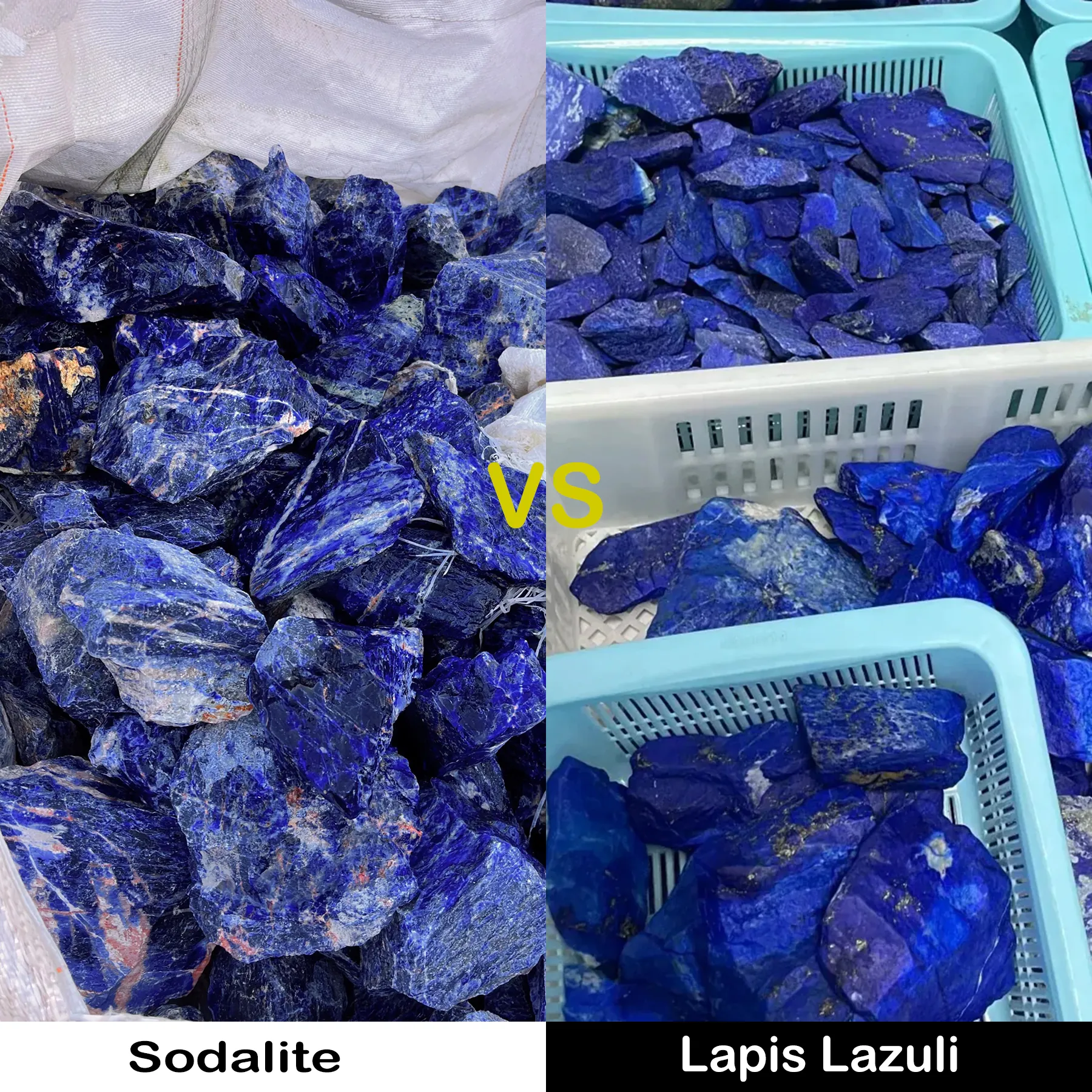
3. How Can You Tell Sodalite from Lapis Lazuli by Eye?
Start with the blue. In typical jewelry-quality material, this is often the easiest difference to see. Sodalite commonly has a softer, grayer or slightly violet-blue appearance, and the blue is often interrupted by cloudy white or pale areas. Fine lapis tends to look deeper in color and more saturated: royal blue, deep blue or slightly violetish blue, with the blue itself remaining the main visual impression.
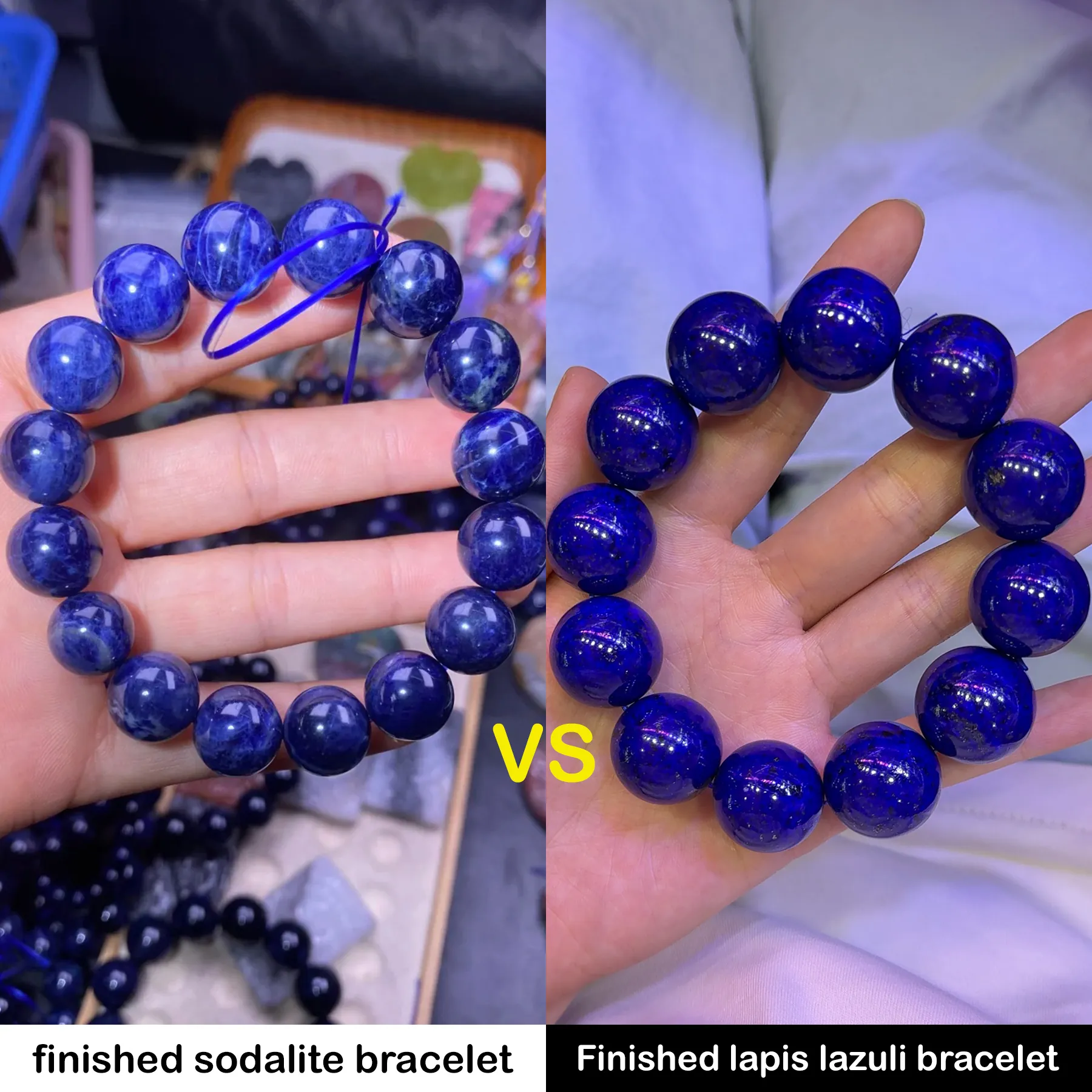
The finished bracelet comparison below shows this clearly. The sodalite on the left has a cooler, softer and more mottled blue with conspicuous pale areas. The lapis lazuli on the right has a stronger, richer blue field, and several beads show metallic gold-colored pyrite. You do not need the pyrite to notice that the overall blue is different.
What to Look For, in Order
- The character of the blue. Sodalite often looks softer, grayer, more violet or more mottled; fine lapis usually looks richer and more saturated.
- How much the white material breaks up the blue. Broad cloudy white areas are common in sodalite jewelry material. Lapis can also contain white calcite, but fine lapis is usually valued for a cleaner, more continuous blue field.
- Metallic pyrite is characteristic of many lapis lazuli specimens and can support a lapis identification, but it should not be used as proof by itself.
- The whole pattern across several beads. A strand or bracelet is easier to judge than one isolated bead because color, white areas and mineral pattern repeat across the piece.
If you want to see how much natural lapis itself can vary from gray-blue to saturated royal blue, compare the examples in our visual guide to lapis lazuli color. That variation is important: a pale or calcite-rich lapis should not be compared with fine royal-blue lapis as though they were one fixed color.
White Veins Can Appear in Both
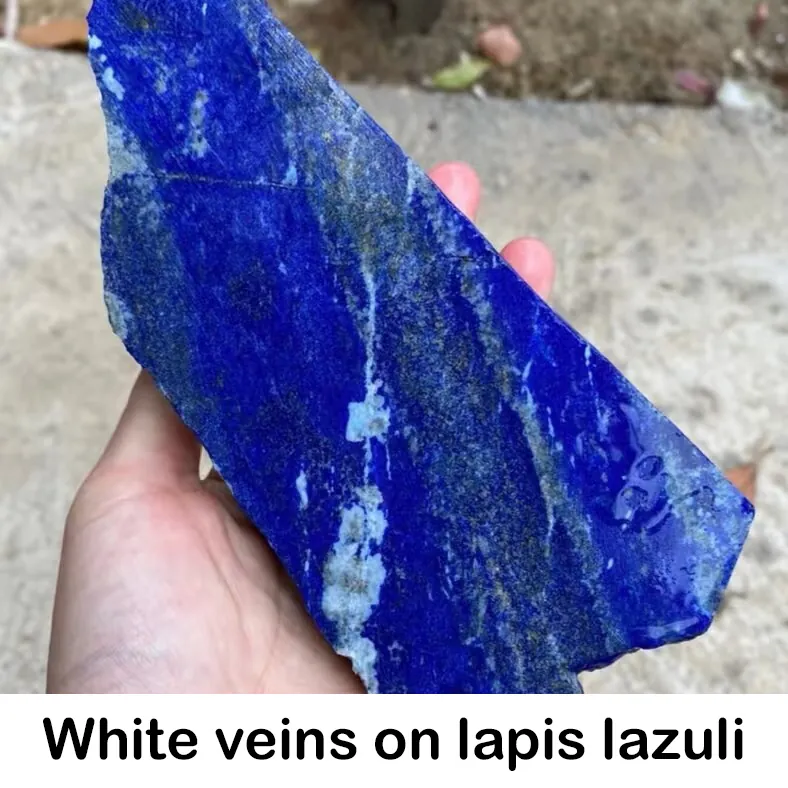
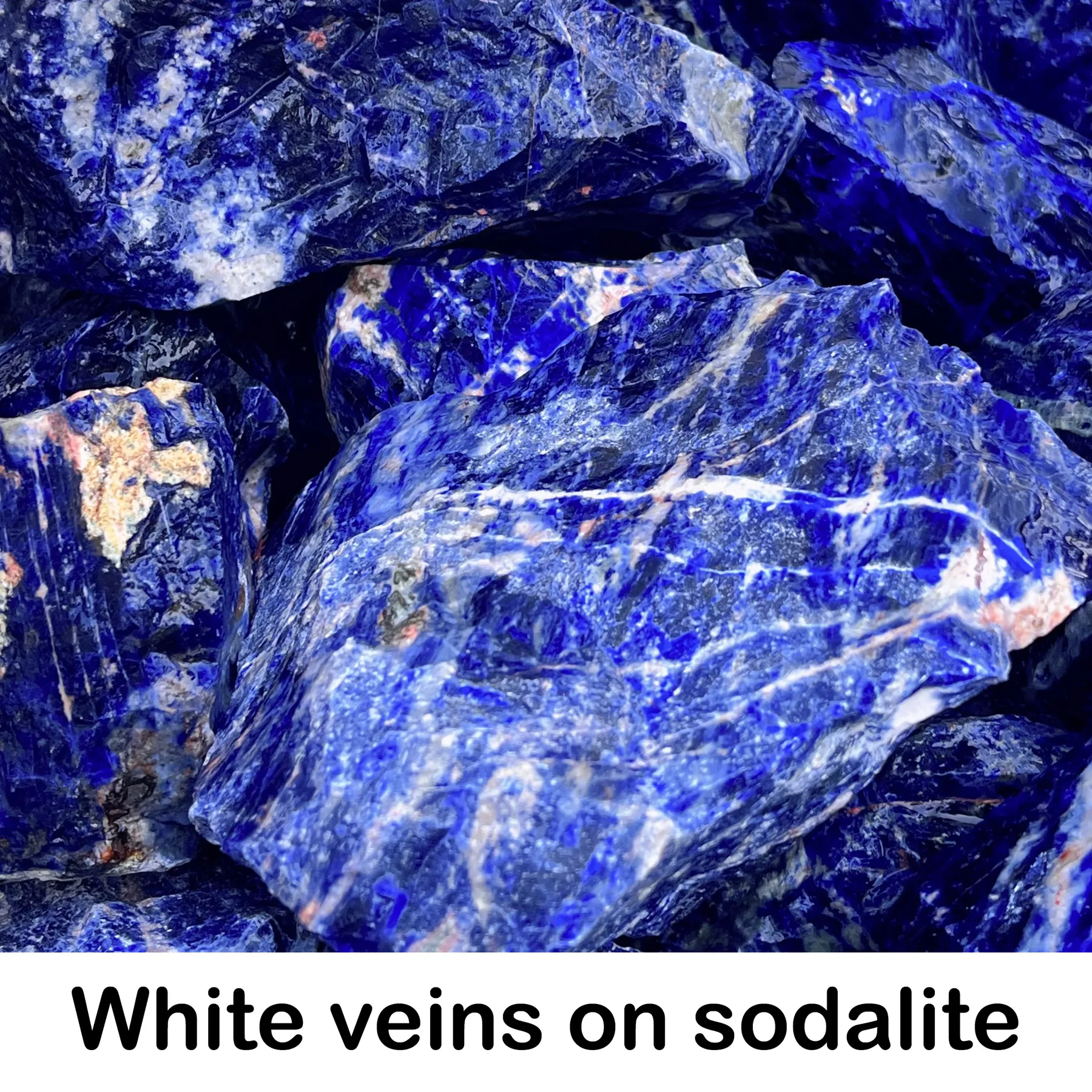
White veining is useful information, but it is not the main separator. Lapis lazuli commonly contains white calcite, and sodalite jewelry material can also show strong pale or white veining. So the shortcut “white veins = sodalite” is not reliable.
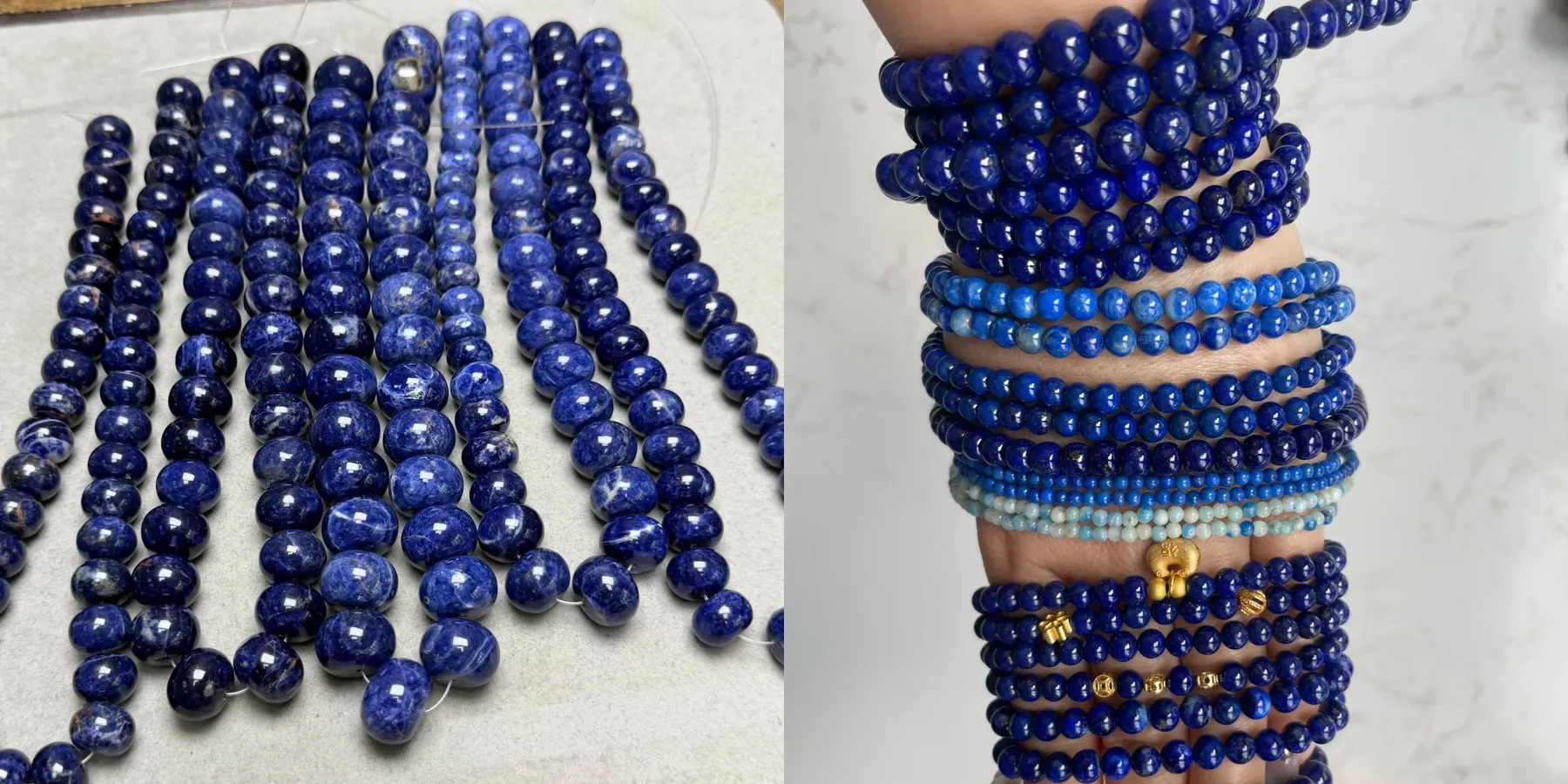
The two images below make the point more clearly than a rule does. Both are blue materials with white veins. The better clue is the blue body around those veins and the overall mineral pattern, not the existence of white material by itself.
4. If There Are No Gold Flecks, Can It Still Be Lapis Lazuli?
Yes. Visible pyrite is common in lapis lazuli and is a very useful clue, but it is not required on every finished surface. Fine lapis can contain very little visible pyrite, and some pieces may show no obvious gold-colored flecks at all.
This is where the order of observation matters. If you start with “find the gold,” a clean high-quality lapis bead can confuse you. If you start with the blue—its saturation, uniformity and overall body color—and then use pyrite as supporting evidence, the comparison becomes more practical.
GIA notes that the most prized lapis can have an intense, uniform blue with no visible calcite and may contain little or no visible pyrite. For a closer look at how fine material changes through cutting and polishing, see what fine Afghan lapis looks like in finished beads and jewelry.
5. Which Is Usually More Valuable, and How Do You Avoid Buying the Wrong Material?
Fine lapis lazuli usually commands a higher market value than common sodalite. The reason is not simply that lapis has a more famous name. High-value lapis is judged heavily on color quality: saturation, uniformity, minimal visible calcite, attractive texture and good polish all matter.
GIA’s lapis lazuli quality factors describe the most valued material as intense, uniform, medium-dark to dark blue or slightly violetish blue with no visible calcite. Small, attractively distributed pyrite can be acceptable, but more pyrite does not automatically mean more value.
Sodalite can still be attractive jewelry material. Its softer blue, white patterning and lower typical price can suit casual bead jewelry very well. The problem is not sodalite itself; the problem is paying a fine-lapis price for sodalite because the seller has used a vague blue-stone description or an oversimplified “looks like lapis” claim.
A Practical Buying Checklist
- Look at the blue before the gold flecks. A rich, saturated royal or violetish blue is characteristic of fine lapis; a softer, grayer, more mottled blue is more typical of sodalite.
- Compare several beads, not one perfect bead. A whole strand reveals the material’s repeated color and mineral pattern much more clearly.
- Do not use white veins as the deciding rule. Both materials can show them.
- Use pyrite as supporting evidence. Gold-colored pyrite is characteristic of many lapis specimens, but pyrite can also occur with sodalite-bearing material, so it should not be used as the only identifying feature.
- Do not perform scratch tests on finished jewelry. Their hardness ranges overlap, and you can damage the polish without getting a reliable answer.
- For expensive purchases, ask what supports the material identification. Reliable sourcing, supplier records and independent gemological testing carry more weight than a seller’s color name.
If you are comparing different grades of lapis rather than simply identifying the material, our lapis lazuli quality guide explains how color, calcite, pyrite, treatment, polish and bead matching affect finished jewelry.
The Short Version
Sodalite and lapis lazuli are not the same stone. Sodalite is a mineral; lapis lazuli is a multi-mineral rock. Their hardness and refractive-index ranges differ, and lapis is generally denser. But for an ordinary jewelry buyer, the most useful first difference is visual: typical sodalite usually looks softer, grayer or more violet-blue and more mottled, while fine lapis usually looks richer, more saturated and more unified in blue.
White veins can occur in both. Pyrite is useful but not mandatory. In most typical bead jewelry, once you know to judge the blue, the white pattern and the pyrite together, sodalite and lapis lazuli are usually not difficult to separate by eye. Borderline or high-value cases are where proper gemological identification matters.
To compare finished examples, browse our lapis lazuli jewelry.